
Finding St. Louis Resident Records
St. Louis has no single public household roll. An address is often the best starting point because the City Address & Property Search is keyed to a street address or parcel, not a person’s name. It can lead to the legal owner, mailing address, parcel number, collector account, neighborhood, ward, precinct, and permit links. A person’s name can instead be checked in a narrowly defined state voter-registration tool, a court litigant index, or an older directory. Each source answers a different question, so an address result should not be treated as proof that every person at that location lives there.
For historical work, St. Louis County Library, St. Louis Public Library, the Missouri Historical Society, and the City Recorder archives offer the material that modern portals omit. The City and adjoining St. Louis County maintain separate systems. Confirm the municipal boundary before ordering a deed, requesting a file, or assuming that a St. Louis postal label belongs to the City.
- Enter a known City address or parcel in the City property search and save the parcel, collector account, legal description, and separate situs and mailing addresses.
- Use the City Recorder’s grantor-grantee index to check an ownership instrument, then retain the book/page or document number with the result.
- For a named person, use Missouri Voter Outreach only as an exact registration check and use Case.net only when the person is a litigant.
- For an earlier household, check an appropriate city-directory year, reverse section, newspaper index, map, or archive collection.
- When an open City record is not online, ask the proper custodian for inspection or copies under the Missouri Sunshine Law.
Note: A blank search result can reflect a boundary error, a restricted record, a different name spelling, or a source that remains at a counter or library.
St. Louis Residents Directory Offices
Several custodians supply the pieces used in a St. Louis residents directory. The City Recorder holds land instruments, archives, and local life-event series. The City address and property service provides an address-to-parcel route. The Board of Election Commissioners directs registration checks. These offices serve the independent City. A County address generally requires County offices and the 21st Judicial Circuit instead.
St. Louis City Recorder
City Hall, 1200 Market Street
St. Louis, MO
(314) 622-4610
City Assessor Records & Mapping
City Hall, Room 114
St. Louis, MO
(314) 622-3212
City Board of Election Commissioners
300 N. Tucker Boulevard
St. Louis, MO
(314) 622-4336
St. Louis City Boundaries Choose the Custodian
St. Louis City is independent from St. Louis County. That legal split affects the Recorder, Assessor, election authority, tax and permit custodian, municipal court route, and circuit court. A ZIP code or a “St. Louis” mailing city does not settle the question. Confirm City Limits in the City GIS layer or use the municipal field in a City property result before relying on a City search path.
The distinction matters most when a record crosses the edge of the City. The City uses the 22nd Judicial Circuit and its own Recorder and Assessor. County matters use the 21st Circuit and separate County offices. Earlier records can also sit in a historical City, County, library, or archive collection because the City separated from the County in 1876 and 1877.
St. Louis Parcel Search Starts With an Address
The City Address & Property Search accepts Street Address or Parcel. Its categories include real estate and property information, boundary and geography, residential services, trash and maintenance, and contacts and elected officials. The public landing page does not offer an owner-name field. Start from the known location, then read the owner field in the result rather than expecting a City-wide name index.
| City search field | How it helps a St. Louis search |
|---|---|
| Street Address or Parcel | Required entry for the address-keyed result. |
| Property information | Links the address to owner, parcel, collector account, value, and legal-description context. |
| Boundary and geography | Shows geographic context such as ward, precinct, neighborhood, and ZIP. |
| Maps and permits | Connects a parcel to parcel, zoning, historic, right-of-way, and permit evidence. |
The City property-search landing page is shown below. A parcel result can provide several useful joins, but the City warns that its online property description is not a legal document.
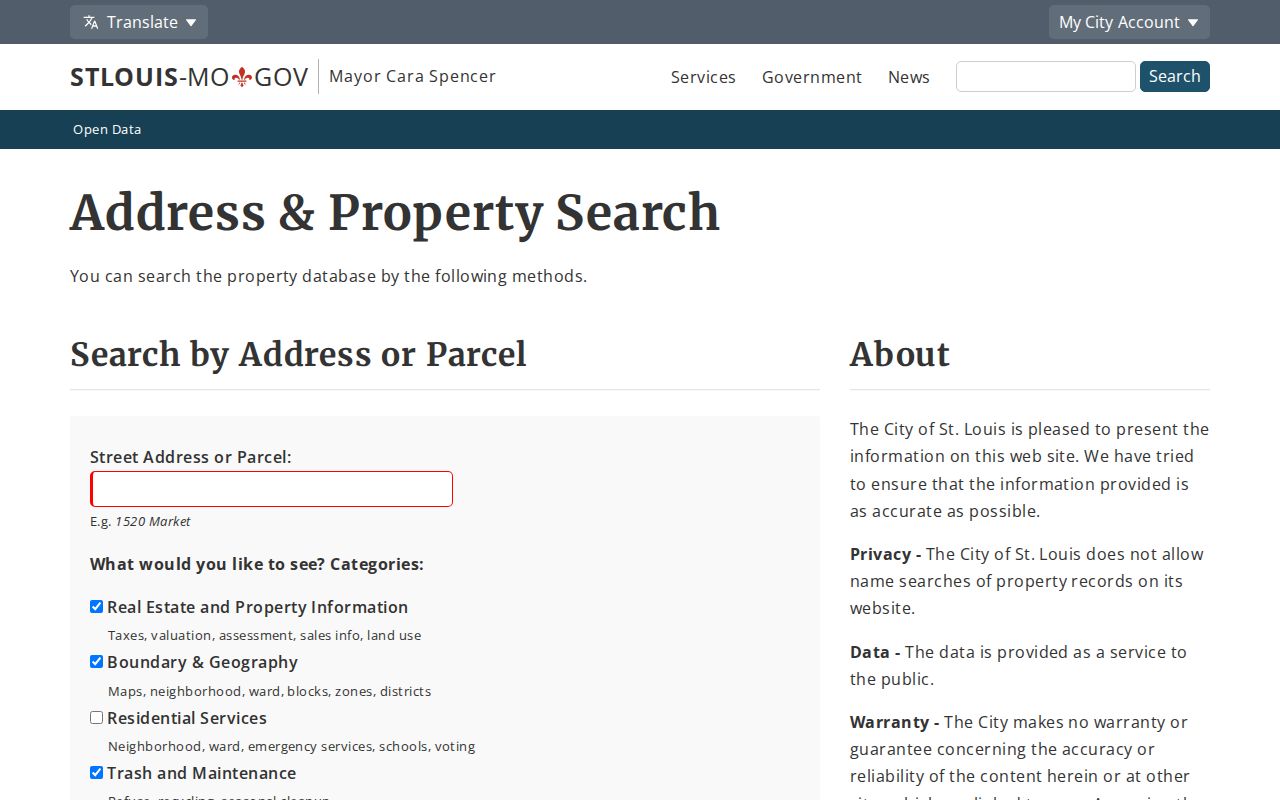
Use the parcel and legal-description information to move to the Recorder, not as a substitute for a recorded instrument.
- Parcel
- A local identifier for a piece of land or a unit, used to join City property and mapping material.
- Situs address
- The physical property location. It may differ from the owner’s mailing address.
- Collector account
- A tax-account identifier that is distinct from the parcel number and can help keep a property trail organized.
- Legal description
- The block, lot, subdivision, or other land description used to identify property in recorded work.
St. Louis Deed Names Follow the Land
For an ownership trail, move from the City result to the City Recorder DirectSearch index. Search the current owner as grantee, then use the prior seller as an earlier grantee. Preserve the recording date, document type, book/page or document number, legal description, and whether an image or copy is available. A deed can name a spouse, trustee, lender, estate, or corporation, so it should identify an instrument party rather than automatically identify a resident.
City guidance describes an online address, grantee, grantor, or parcel workflow for July 1982 forward. Earlier work may need the Recorder or Assessor counter, public computers, old books, or book/page information. The Recorder accepts in-person and mail requests as well as its online channels. A book/page search at the counter is usually completed in about 15 minutes when the reference is known, while mail is often handled the next day.
Note: A missing online deed result does not prove that a St. Louis property had no earlier owner or that its older instrument is unavailable.
Current St. Louis Resident Directories
Current St. Louis directory evidence is spread across official indexes. The City property page identifies a current owner at a known parcel. The Recorder index identifies parties to recorded instruments. Voter lookup is an exact registration check. Case.net identifies litigants, not every witness or resident. Business and professional registers establish an organizational or credential connection, not necessarily a home address. Use the source that matches the question and record its access limit beside the result.
| St. Louis source | What it can identify | Custodian | Access route |
|---|---|---|---|
| City address/property result | Current owner, mailing and situs address, parcel context | City Assessor | Free address or parcel search |
| Voter registration | Matching registered voter and district clues | Missouri election authorities | Exact-person lookup and limited request routes |
| Recorded instruments | Grantors, grantees, legal descriptions, and dates | City Recorder | Free index, paid copies or counter help |
| Case.net | Litigant, case, docket, and disposition information | Missouri Courts | Public web search and courthouse terminal |
| RNO directory | Public neighborhood-group contacts and meetings | City Neighborhood Stabilization Office | Registry and association directory |
When the aim is to verify one named person rather than understand a record type, use the focused St. Louis resident lookup workflow. It separates same-name results and restricted records from usable public evidence.
St. Louis Voter Records Have Exact Limits
Missouri Voter Outreach requires the registered first and last name, date of birth, last four Social Security digits, and county on the inspected state form. City guidance also directs voters to the City Board of Election Commissioners for help with inactive or nonstandard-address results. The public voter-file statute, RSMo 115.157, describes fields such as name, year of birth, address, ward, and precinct, but it does not make an online search a complete residents directory.
Protected records and Safe at Home addresses are not ordinary public address fields. A fee-based voter-file request may be available through an election authority for defined geography or election history, but the research does not establish a City-wide public name roster. Voter information is also subject to restrictions on commercial use and misuse. Treat a registration match as one confirmation layer.
St. Louis Court and Custody Sources Are Narrow
Case.net searches a person only when that person is a litigant. It supports litigant name, filing date, case number, and scheduled-hearing routes. City municipal instructions point to the 22nd Judicial Circuit and permit an optional date of birth, St. Louis City Municipal location, and Traffic/Municipal case type. Sealed, juvenile, adoption, expunged, and other protected material does not become visible merely because a name is searched.
The City’s inmate locator is a separate, exact first-and-last-name tool. Its results are limited to custody information such as name, birth year, race, sex, and facility. A blank result can reflect release, transfer, a spelling mismatch, or police custody. Call the City Justice Center or Prisoner Processing for a current-status question rather than stretching an online result beyond its purpose.
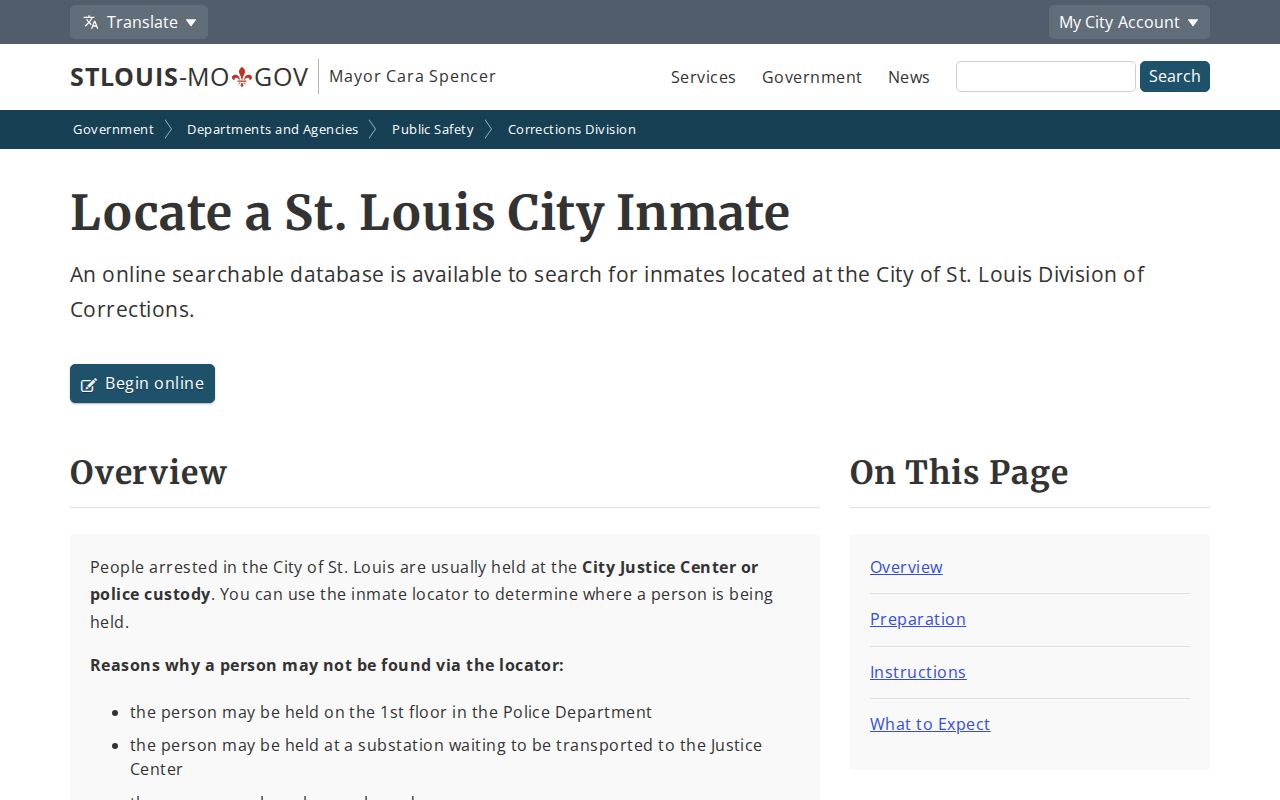
The City instructions show why an exact name is important and why a custody search is not a general St. Louis resident record.
Historical St. Louis Resident Directories
St. Louis County Library holds a remarkable city-directory run: 1821, selected 1840s and 1850s volumes, every year from 1864 through 1931 on microfilm, and later selected years through 1980. Its shelves also include business directories, telephone books, maps, court transcriptions, burials, death registers, and local histories. A reverse section documented in the 1922 city directory runs from address to occupant, which can be useful when the name is unknown.
St. Louis Public Library adds local-history research, obituary indexes, licensed databases, maps, and special collections. The Missouri Historical Society can search by personal name, business or corporate name, street address, and source. The fuller St. Louis city directory collection guide explains how to read a volume and pair a yearly entry with maps and census material.
St. Louis Libraries Keep the Missing Years
Online access is uneven. A directory volume may be on microfilm, microfiche, print, a library database, or an archive shelf instead of on an open website. Ask a St. Louis County Library History & Genealogy staff member for the correct year and format, or use St. Louis Public Library’s genealogy and St. Louis Room resources. These channels can connect a directory entry to an obituary index, newspaper reel, Sanborn map, cemetery source, or probate lead.
The City property service showed a data-connection problem when the research was inspected in August 2026. That makes an office, library, or archive fallback practical rather than theoretical. A City Recorder archive search can also address historic birth, death, marriage, land, and genealogy material when a modern portal does not carry the necessary year.
St. Louis Vital Records Require Eligibility
Missouri vital records are not open as a general name-search collection. The Department of Health and Senior Services requires authorization or tangible interest for modern certified copies. In-person applicants show identification. Mail requests use a signed, notarized application, fee, supporting documents when required, and a self-addressed stamped envelope. The state register begins in 1910 for births and deaths, while statewide marriage and divorce statements begin in 1948.
Missouri’s official order guidance explains the required application path. Death copies more than 50 years old may be disclosed under RSMo 193.245, and pre-1910 genealogy sources are available through Missouri Digital Heritage. The City Recorder archives also hold older City search services, including marriages from roughly 1805 or 1806 through 1931.
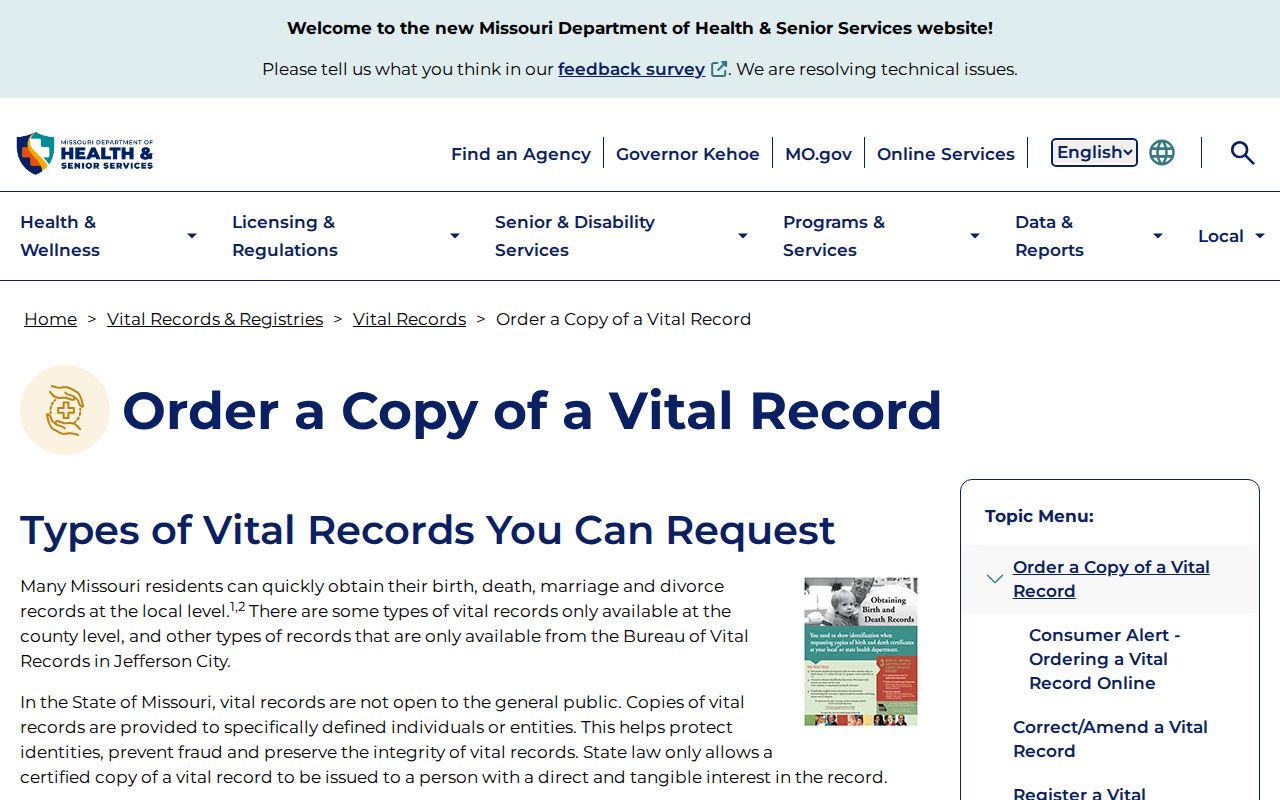
The state order screen is a request path, not an unrestricted St. Louis resident search.
St. Louis Residents Directory History Trails
An old address can become a family-history trail when a same-era directory, deed, obituary, and probate record agree. A directory may supply an address and occupation. A recorded instrument can establish an ownership change. An obituary can provide a death date, relatives, or final-address clue. Probate may identify an estate representative or an heir. Each step should retain the source date and record type rather than flattening all names into one identity.
City archive resources, library obituary indexes, and cemetery material are useful historical endpoints. Washington Park Cemetery North has a City archive reinterment index covering 11,974 deceased people, including 165 entries identified as Doe. The City reports no records for Washington Park South, a useful reminder that a documented absence should be recorded as an absence, not converted into a conclusion about a family.
St. Louis Registry Searches Need Context
The Missouri State Highway Patrol’s public sex-offender registry is a separate official tool with name, date-of-birth, city, county, ZIP, street, and address-radius criteria. It updates daily, but its map is not complete and the search includes use limits. The City locator, Missouri Department of Corrections search, and federal custody locator cover different systems. A City arrest does not automatically create a state custody record, and a registry result is not a complete biography.
The Missouri registry search interface shows the separate name and address-radius controls. Use the appropriate official source for a public-safety question and retain its coverage limit with the result.
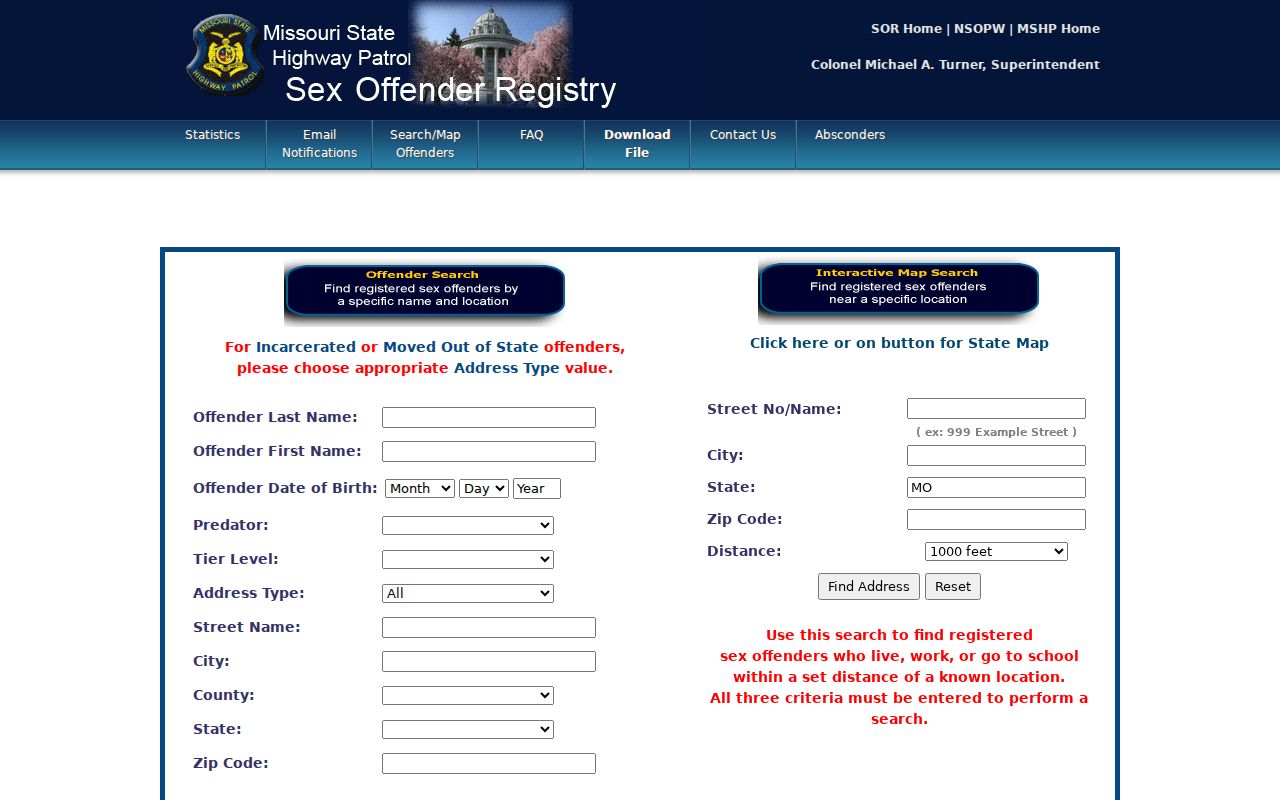
This search screen reinforces that location fields are filters within one registry, not a household directory for St. Louis.
St. Louis ZIP Labels Are Not City Limits
ZIP codes are delivery geography. They do not define the independent City boundary, a neighborhood, ward, precinct, or the office that holds a record. The City GIS service includes ZIP Codes, Neighborhoods, Wards, City Blocks, City Limits, and related layers. A property result can also show local geographic context. First standardize a known address with USPS, then confirm the City boundary and parcel before choosing the City or County path.
The conventional City ZIP list includes 63101 through 63120 in specified areas, then 63139 and 63147, alongside special or unique delivery codes. Several nearby County ZIPs also use a St. Louis mailing label. The dedicated ZIP directory keeps the delivery geography separate from records jurisdiction.
St. Louis Record Claims Need Source Checks
Official records and compiled commercial listings are not equivalent. A custodian’s result identifies a particular record, access condition, and date. A compiled listing may be stale, conflate people with the same name, or carry an old mailing address forward. A useful check compares at least two independent identifiers, such as a name and parcel/legal description or a name and documented organizational affiliation, before treating a match as belonging to one person.
| Record path | Best use | Key caution |
|---|---|---|
| Official custodian index | Verify a specific public record or instrument | Coverage and access vary by office and year. |
| Library or archive collection | Trace a historical person, address, or local event | Many volumes require an in-person visit or reference help. |
| Compiled commercial listing | Possible lead only | Confirm every claim with the underlying custodian. |
St. Louis Fraud Warnings Follow Parcel Searches
Property records can attract deceptive solicitations. The City Recorder’s official land guidance is the safe starting point for a deed copy or Property Fraud Alert information. Compare any mailed offer with the Recorder’s fee schedule and call the office rather than using the number or payment link on the mailing. After the May 2025 tornado, the City postponed a real-estate tax sale affecting 1,264 properties and warned about predatory letters and payments.
Unclaimed-property claims are another place to use a primary source. The Missouri Treasurer’s search says the State does not charge to claim property. Preserve the letter, envelope, payment demand, and URL when reporting a deceptive solicitation to the Missouri Attorney General’s consumer-protection office.
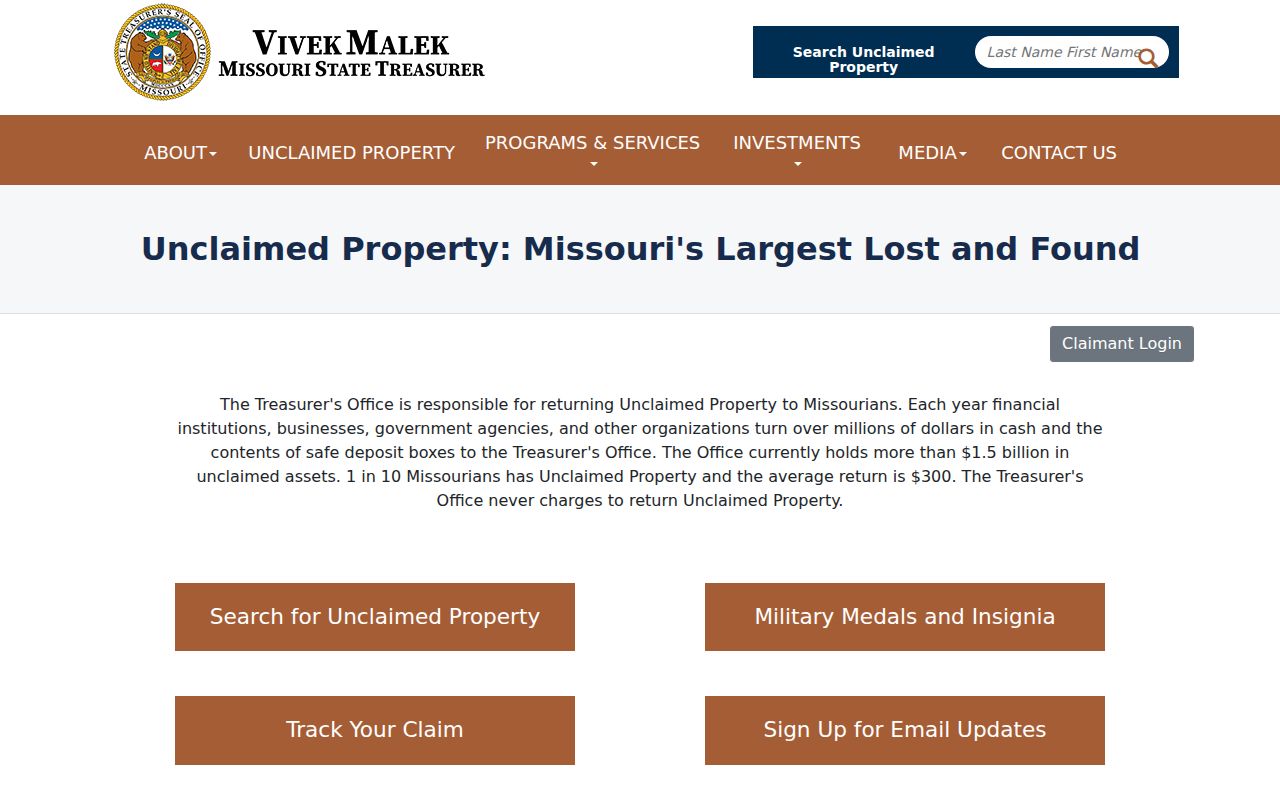
The State’s own claim screen is the appropriate point of comparison for a fee demand that uses a St. Louis name or address as a hook.