
St. Louis Resident Lookup Records
Verification in St. Louis is a process, not a single public roll. The City is independent from St. Louis County, so an address inside the City normally leads to City offices and the 22nd Judicial Circuit. A nearby suburban address can belong to the County and the 21st Circuit. Start by identifying the address jurisdiction, then choose the record that answers the exact question. An official result may confirm a limited fact without proving where someone currently lives.
| Record | What It Confirms | Where | Access |
|---|---|---|---|
| City parcel or property record | Owner, situs, owner mailing address, parcel, and property context | St. Louis City Address & Property Search | Free address or parcel search; no online owner-name search |
| Recorded instrument | Grantor, grantee, transfer, legal description, liens, or affidavits | City Recorder DirectSearch | Index search is free; copies or images can carry charges |
| Voter registration | Matching registration status, address, year of birth, and districts | Missouri Voter Outreach | Exact personal fields required; protected data stays closed |
| Court case | Litigant role, case number, filing date, case type, and public docket | Missouri Case.net | Public index with protected and sealed categories excluded |
| Vital or archive source | Life event or historical relationship evidence | Missouri DHSS and City archives | Modern copies restricted; historical paths vary |
| License or filing | Credential, organization affiliation, registered entity, or agent information | Professional Registration and state business services | Public fields and result detail vary by register |
Use an address or parcel first when one is known, because the City property portal is address-keyed. A name alone may be better suited to Case.net, the voter check, an archival name index, or a board-specific credential search. Keep owner mailing address and property situs separate. They can be different, and neither field creates a complete household list.
Defining a St. Louis Resident
Before a one-person St. Louis search, normalize the name. Write down the exact spelling, middle initial, suffix, alternate surname, married or maiden form, and common misspellings. Also record the date searched. A matching name is only a lead. Missouri records often provide a partial identifier, such as a case filing date, year of birth, parcel number, organizational affiliation, or court jurisdiction. Two independent details should agree before a result is described as belonging to one person.
The City property search is useful only after an address or parcel is known. It can show the owner and mailing address on a parcel result, but the City does not offer a public online owner-name search. Do not reverse that limitation by treating an address result as proof of every person there. If the goal changes from an address to a whole street, use the separate St. Louis street directory workflow instead of extending a one-person result beyond what it shows.
Note: Preserve the source date, because parcel ownership, court dockets, registration status, and license details can change.
St. Louis Court Record Names
Use Case.net and Show Me Courts when the person is a litigant, not simply mentioned in a matter. Missouri’s portal offers Litigant Name, Filing Date, Case Number, and Scheduled Hearings and Trials routes. For a City municipal matter, the City directs searchers to select City of St. Louis, 22nd Judicial Circuit. The City instructions also identify optional date of birth, location, and traffic or municipal case-type refinements. A County matter uses the separate 21st Circuit selection.
| Litigant Name | Last and first name are required in name-search mode; the person must be a litigant. |
|---|---|
| Date of Birth | Optional identifier for separating same-name people; City instructions use MM/DD/YYYY. |
| Case Number | Known, exact case identifier for the case-number route. |
| Filing Date | Date criteria with court selection for the filing-date route. |
| Court and Location | Select the City 22nd Circuit or County 21st Circuit as applicable; City municipal is a named refinement. |
St. Louis City Municipal Court search instructions show the City route to Case.net.
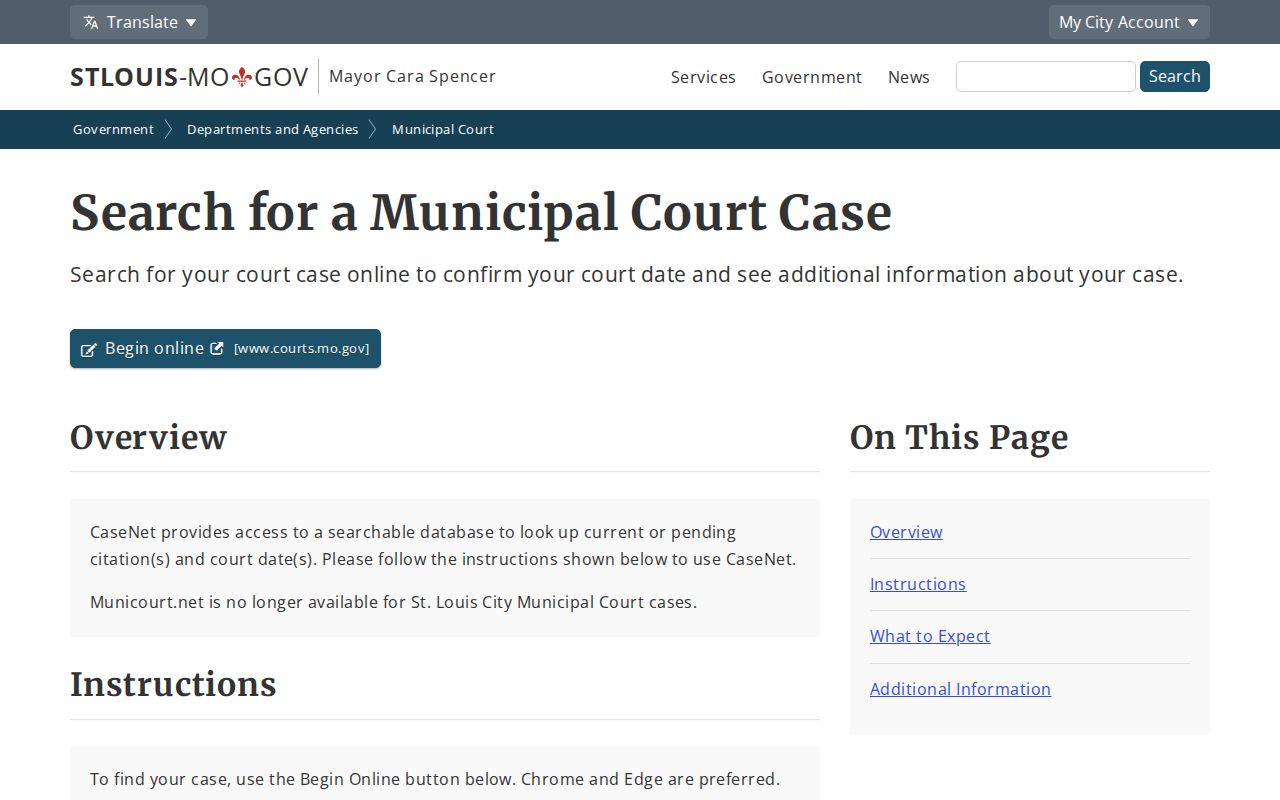
The City moved new municipal cases to Case.net on January 2, 2024. Older missing municipal cases may need a check at the customer window with photo identification or a call to the court, and citations can take time to post.
St. Louis Court Result Details
A Case.net result supplies a limited public docket inventory. Read the case number, style or caption, case type, filing date, party name and role, attorney information, docket entries, scheduled events, and judgments as separate fields. A party address can appear in public material, but court redaction and role rules control that field. Linked documents appear only when public remote access is allowed. An E-CASE or restricted result calls for a courthouse public-access terminal or the clerk, not a guess about what the file contains.
- Case number, case style, case type, and filing date.
- Party name, party role, and attorney information.
- Docket entries, hearings or trials, and public judgments.
- Judgment amount where the public docket supplies it.
- Public linked documents where remote access is permitted.
- Restrictions for sealed, expunged, juvenile, adoption, and other protected matters.
The City inmate locator, state Department of Corrections system, and federal Bureau of Prisons locator are distinct custody systems. A City exact-name result can show name, birth year, race, sex, and facility, while a no-result can reflect a spelling difference, release, transfer, or police custody. City Justice Center or Police Prisoner Processing staff provide the documented phone fallback for a current City arrest. A court hit does not establish custody, and a custody record does not establish a conviction.
Verifying a St. Louis Resident
A careful search connects a name to an address and then checks independent records. Start from a known City address or parcel where possible. The owner field and mailing address on a parcel result provide a specific lead, while DirectSearch can confirm an instrument tied to the property. Use exact voter information only for registration verification, then search a litigant name in the correct court. For an older question, a historical directory, obituary, or archive index is usually a better first source than a restricted modern certificate.
- Record the full name, alternate spellings, known address, and a second identifier such as a year of birth or a case number.
- Search the City property page by address or parcel, and keep the owner mailing address distinct from the situs address.
- Check DirectSearch for a matching grantor, grantee, legal description, or recorded instrument when the property link is relevant.
- Use the Missouri voter lookup and Case.net in the correct City or County jurisdiction to test independent details.
- Use a historical index, obituary, directory, or eligible certified copy request only for the limited fact it can verify.
- Docket
- A court’s running list of filings, events, and orders in one case. It is not the same thing as every document in the file.
- Index versus image
- An index points to a record and may be free to search. An image is a view of the document or page and can be restricted or carry a copy charge.
- Certified copy
- A copy issued and authenticated by the custodian for a record that the applicant is authorized to receive.
Note: A name plus one matching detail is not enough when another St. Louis person could share the same name.
St. Louis Voter Records
City election guidance routes a one-person verification to Missouri Voter Outreach. The inspected state form requires first name as registered, last name, date of birth in MM/DD/YYYY form, last four digits of the Social Security number, and county. Do not publish or retain a personal Social Security number. A no-result can reflect inactive status, nonregistration, a mismatch, or protected information. The City Board of Election Commissioners can help by phone or at its counter when an address is nonstandard.
| First Name | Exact first name as registered. |
|---|---|
| Last Name | Exact registered last name. |
| Date of Birth | Required MM/DD/YYYY entry on the inspected form. |
| Last 4 SSN | Required numeric entry on the inspected state form; never retain it. |
| County | Required selection; choose the City or County jurisdiction that fits the address. |
RSMo 115.157 makes selected voter fields public while protecting other fields and protected addresses. It does not make ballot choices public. A fee-based voter-file request can have lawful public-record uses, but the statute restricts commercial use and misuse. Ask the City Board, rather than assuming the County request form or price applies within the independent City.
St. Louis Credential Records
A professional credential or state filing can help distinguish an organizational connection from a residential one. The Missouri Division of Professional Registration offers Licensee Search and board-specific results. Official real-estate guidance describes choosing Licensee Name, entering a name in a surname-first form, then opening Detail for information such as name, license number, expiration, and affiliation. Other boards use different fields, so an absent option should not be invented.
The state licensee-search gateway is one official source that may help separate namesakes.
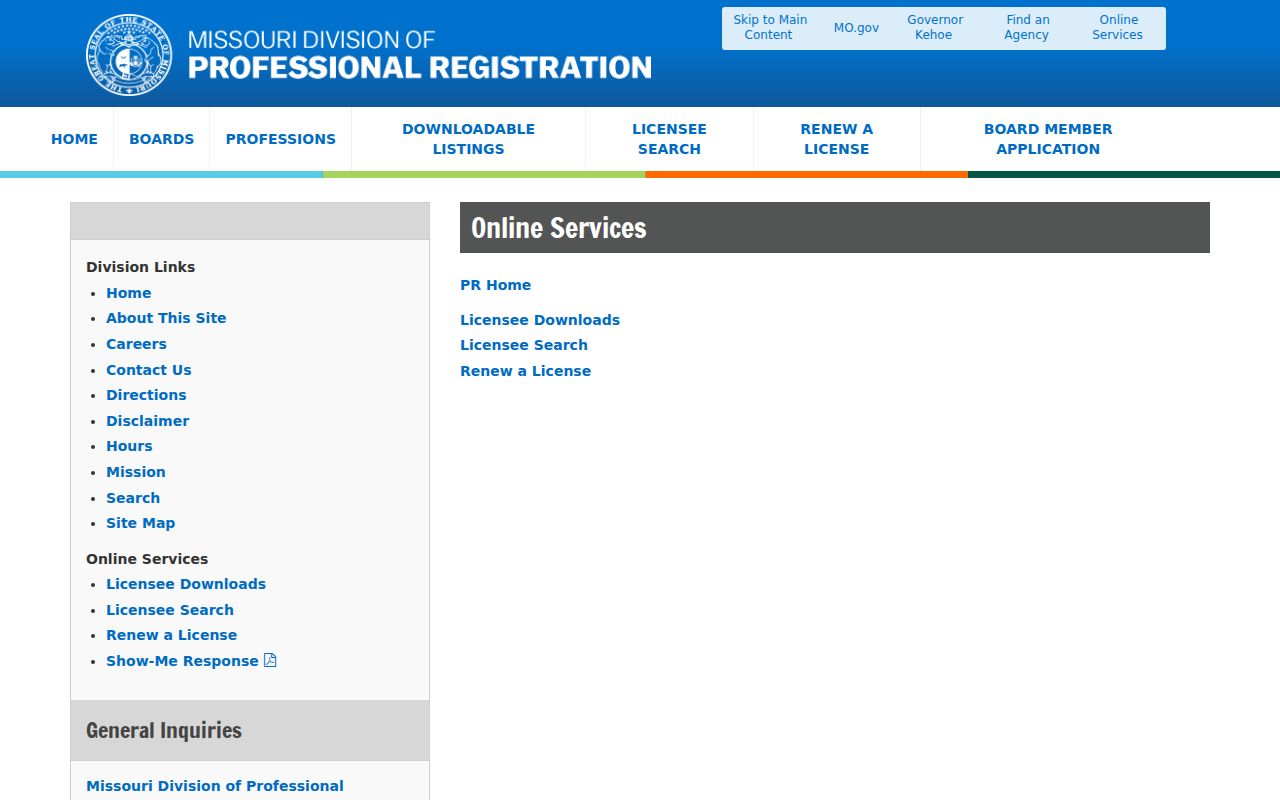
The image represents a credential route, not a general person record. State business services can show a registered entity, agent, officer, filing history, or business address. Those roles and addresses should be labeled accurately and should not be treated as a current private address.
For a name that remains unclear, the Division of Professional Registration accepts phone questions at (573) 751-0293. A board can explain its public result or a certified history request. A Sunshine request can seek an otherwise public list or policy, but not confidential complaint material.
St. Louis Vital Record Access
Modern Missouri birth and death certificates are not open to the general public merely because the event occurred in St. Louis. The DHSS order guidance requires authorization or tangible interest. For a targeted birth or death request, use the correct state or local office based on the year and record type. The state form asks for event details, relationship or tangible-interest material where required, copies, purpose, and applicant contact information. An in-person applicant signs, pays, and presents the required identification. A mail request requires a signed, notarized application, fee, supporting documents, and a self-addressed stamped envelope.
Phone staff can clarify the correct custodian without releasing a restricted certificate. DHSS Vital Records is reachable at (573) 751-6387; the St. Louis City Recorder is (314) 622-4610, and its archive room is (314) 622-4546. For historical research, pre-1910 births and death certificates more than 50 years old have genealogy paths described by the state. City archive material includes marriages from roughly 1805 or 1806 through 1931, births roughly 1870-1909, and deaths roughly 1850-1909. Newspapers, church registers, cemetery records, and library indexes can supply historical evidence but are not certified copies.
When a municipal record is otherwise public but a portal or counter route fails, the Missouri Sunshine Law allows a focused request to the custodian. Identify the record, date range, preferred format, and whether copies are needed. Under RSMo 610.023 through 610.026, the custodian should act as soon as possible and no later than the end of the third business day or explain a delay. A request cannot override the statutory confidentiality of a vital certificate. Ask for the cited exemption if access is denied.
Note: A historical index can support a family-history question, but only the authorized custodian can issue a certified copy.
St. Louis Heir Records
For a deceased St. Louis resident, an obituary, probate filing, and deed transfer can connect an old address to an estate or heir. Begin with a historical directory or newspaper date, then search the appropriate probate or circuit docket by the decedent or estate name. A public filing may identify a petitioner or other party. Compare that result with an obituary and a recorded transfer before describing a relationship. Exact St. Louis probate online fields and copy charges were not located in the official research, so use the clerk or archive for the next step rather than assuming a portal result is complete.
Former-classmate research belongs in yearbooks, directories, newspapers, and special collections. SLPL, SLCL, and Missouri Historical Society resources offer historical starting points. The City directory collections provide the broader historical address layer for a name found in those sources.
St. Louis Protected Records
Missouri’s Safe at Home program gives qualifying participants a substitute address that government agencies and courts must accept for new records. It does not automatically erase older records created before certification. Voter participants use the substitute address through the program. Court systems also restrict juvenile, adoption, sealed, expunged, protection-order, and other protected material. A missing address may be intentional rather than an error.
Lawful use. Use a St. Louis resident lookup for personal, lawful research and keep sensitive details limited to the purpose at hand. Using records to stalk, harass, or intimidate another person is prohibited and may violate Missouri law.
For an inaccurate record, contact the source custodian with the precise source URL, inspection date, parcel, case, license, or document number, plus supporting correction material. Ask for the office’s amendment, redaction, sealing, expungement, or Safe at Home routing. A profile removal from a commercial service does not correct the City Assessor, Recorder, court, voter, license, or newspaper source behind it. The Missouri Attorney General’s consumer-protection portal is the state route for deceptive-practice guidance.