
St. Louis City Directory Shelves
The St. Louis County Library directory holdings preserve a long, uneven local run in print, microfilm, and microfiche. The 1821 volume is available on microfiche. Later holdings include selections from the 1840s and 1850s, an annual city sequence from 1864 through 1931, and selected later volumes. Those records can place a person at an address, identify an occupation or business connection, and show annual moves. They are historical address evidence, not proof that every person at a location was listed.
| Collection | Years | Where Held | Access |
|---|---|---|---|
| St. Louis city directories | 1821; selected 1840s-1850s; every year 1864-1931; selected 1932-1980 | St. Louis County Library History & Genealogy holdings | Print, microfilm, or microfiche |
| St. Louis business directories | 1860, 1863; 1902-1907, 1911-1916, 1918-1928 | St. Louis County Library | Print and microfilm holdings |
| Reverse or criss-cross directory | Documented at the back of the 1922 city volume | Library holdings and local house-research guide | Consult the physical or filmed volume |
| City and county telephone books | 1968-1972 and 1974-1975 listed | St. Louis County Library desk holdings | In-library print reference |
The gaps matter. The listed series combines annual stretches, combined editions, and selected later years, so a missing name can reflect the surviving run, an indexing choice, a move, or an omission. The research guide identifies a general city run through 1980 and a Fold3 city-directory run for 1863-1923, but it does not support a claim that every volume is digitized or available from home.
Note: Record the library format and exact year before treating a gap as evidence that a household left St. Louis.
St. Louis Directory Years
St. Louis directory history begins with the 1821 city volume. The annual 1864-1931 run is especially useful because it can show a household changing addresses in the years between federal censuses. Later library holdings include 1932-1942, 1944-1946, a combined 1947-1948 edition, 1952, 1955-1961, 1963-1965, 1967-1968, 1969-1975, 1976-1977, and 1980. Business directories and phone books can fill some later gaps, but they answer a narrower question than a full household listing.
| 1821 | Earliest identified St. Louis city directory in the local holdings. |
|---|---|
| 1864-1931 | Annual city volumes on microfilm at St. Louis County Library. |
| 1922 | First documented reverse section appears at the back of the city directory. |
| 1980 | Latest selected city volume specifically listed in the library holdings. |
St. Louis also has a records-geography problem. The City separated from St. Louis County in 1876 and 1877, so a historic source labeled “St. Louis” may sit with a city custodian, a county collection, or a state archive. Pair the event date and historical jurisdiction with the volume citation. That prevents a city directory search from being confused with an adjoining-county record.
St. Louis Directory Library Access
SLCL History & Genealogy brings directories together with maps, civil records, court transcriptions, death registers, burial books, and the 1878 Pitzman atlas. Its format matters: use a microfilm or microfiche reader for a cited year, then ask reference staff about companion maps, newspapers, or local histories. When a remote portal is unavailable, a local-history appointment and the correct reel often provide a more reliable path than repeatedly searching a modern index.
The library's directory-holdings page lists the St. Louis city directory collection in its current holdings inventory.
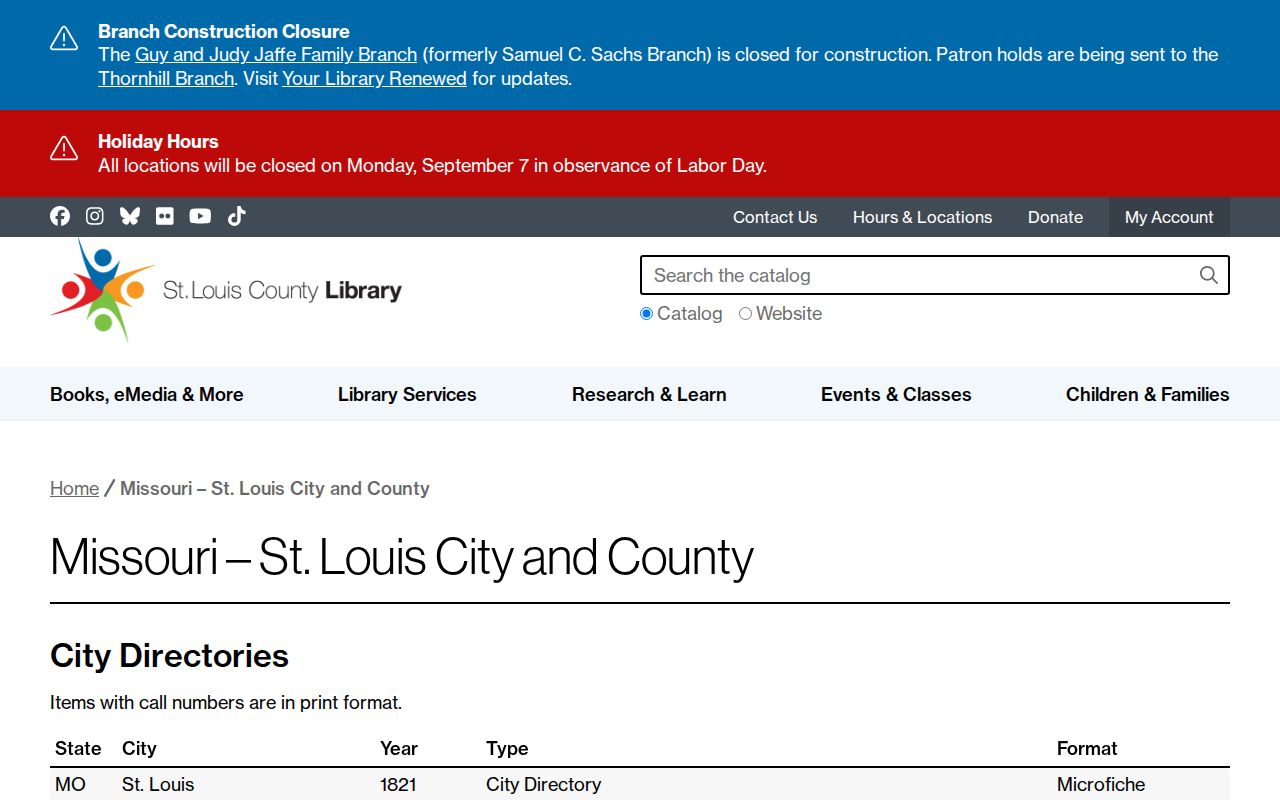
The holdings view is a useful reminder to check both the year and the format before planning a visit. A library-card database or an in-library terminal may supplement the shelf, but remote access is not universal in the available research.
St. Louis Public Library genealogy resources add in-library Ancestry Library, FamilySearch affiliate access, Digital Sanborn maps, Fold3, newspaper resources, and digital collections. The Central Library’s Special Collections on the third floor includes the Genealogy and St. Louis Room collections with reference assistance.
Note: A library index or transcript is a research lead, so retain the original directory citation when possible.
St. Louis Directory Address Index
The Missouri Historical Society street-address search is a separate but useful companion to the directory shelf. It accepts an optional street number, a street name without its suffix, and wildcard searching such as 12** for the 1200-series. Its scope is mostly city material with some county sources. A hit can identify a person, a business, an address reference, or a source, but it is not automatically a scanned directory page.
That distinction protects the search trail. The Historical Society index can surface an old address or a spelling variant, then the cited source, directory volume, map, or photocopy request supplies the evidence to inspect. The 1858 Sketch Book of Saint Louis and an 1889 progress-and-prospects source showed last name, first name, alternate or corporate name, and address fields during research. Check the same-era map and directory before treating an old street spelling as its current form.
Reading St. Louis Directory Entries
A city directory entry is compact. Start by copying it exactly, including initials, punctuation, and abbreviations. A physical volume normally gives a surname and given name, street address, occupation or business notation, and sometimes a spouse or household clue. A widow notation, boarder notation, owner mark, or other household indicator can vary by publisher and year. The surviving research does not establish one universal key for every St. Louis volume, so inspect the front matter of the exact edition before expanding a mark.
| Name | Surname, given name, initials, and source spelling as printed. |
|---|---|
| Occupation | Work or business notation that helps distinguish people with the same name. |
| Address | House number and street, copied with the same-year form. |
| Spouse or household clue | Parenthetical or other notation that may help separate a family from another namesake. |
| Ownership notation | A publisher-specific owner, boarder, widow, or household mark, if the volume supplies one. |
- Criss-cross directory
- The address-order part of a directory, used to move from a street number to a listed occupant. St. Louis has a documented example in the 1922 volume.
- Householder index
- A listing arranged around household heads or addresses rather than every person who may have lived there.
- Abbreviation key
- The publisher’s explanation of shorthand, usually in the volume’s preliminary pages. Photograph or transcribe it with the entry.
Note: A directory entry is contemporaneous evidence, but it needs another source before it establishes identity or family relationships.
St. Louis Directory Maps
Maps stabilize an address when a directory and a modern street view do not line up. The local house-research guide names the 1852 Hutawa map, 1857 atlas, 1871-1872 county atlas, 1875 Pictorial St. Louis, 1878 Pitzman atlas, and 1952 Handy Atlas & Directory. Sanborn maps cover 1867-1970 through library resources, and the Library of Congress 1909 St. Louis volume offers a free online route to its sheets.
Use a same-era map to test the block, street name, and building footprint. The research does not identify a single citywide renumbering year, so do not assume an unmatched number is a simple conversion. Keep the old directory form, map citation, and later address separately. That preserves the record trail when a neighborhood label or city boundary changes.
Tracing St. Louis City Directories
Follow a household through the directory years one year at a time, especially around a marriage, death, business change, or address move. The most useful sequence begins with a surname and known address in the correct period, then checks nearby editions instead of jumping decades. Federal censuses add household context for released years, while the directories supply annual movement between them. The federal 72-year release rule means later decades need historical directories, newspaper files, or appropriate current official records rather than an unreleased census schedule.
- Find the earliest St. Louis directory year that matches the surname and street number, then copy the entry exactly.
- Check the editions immediately before and after it for an address change, new notation, altered spelling, or a different household role.
- Use the documented 1922 reverse section, when the year fits, to test who was listed at the address when a person’s name is unknown.
- Pair the directory period with the released 1900 through 1970 federal censuses, and note where the 72-year rule leaves a later gap.
- Use an obituary, cemetery record, probate item, or recorded transfer to explain a disappearance rather than assuming one cause.
A person who disappears may have moved, died, been omitted, changed a name form, or shifted to a different address format. The Post-Dispatch and Globe-Democrat holdings offer dated follow-up paths. Their local obituary-index windows include 1880-1930, 1942-1945, 1960-1969, and 1992-2011. A death notice can give relatives or a last address, while probate may connect an heir to an earlier property trail.
St. Louis Directory Endpoints
For older St. Louis research, directories work best with the City Recorder archives, newspapers, cemetery material, and library collections. The Recorder’s historic archive material includes marriage searches from about 1805 or 1806 through 1931, births roughly 1870-1909, deaths roughly 1850-1909, and a pre-1917 adoption-deed card index. Those are distinct archive searches with their own rules and charges, not modern vital certificates.
Washington Park Cemetery North is another carefully bounded source. The City archive’s reinterment index covers 11,974 deceased people, including 165 Doe entries, but the City reports no records for Washington Park South. That documented absence matters as much as an index hit. A cemetery, obituary, or archival index should be labeled as historical evidence and compared with the relevant custodian record.
St. Louis Directory Jurisdictions
St. Louis City is independent from St. Louis County. That fact shapes historical research because the City Recorder, City archives, county collections, and state archives may hold different parts of a trail. A mailing address or a reference that simply says “St. Louis” does not select the custodian. For records near the old city edge, identify the jurisdiction at the event date, the source volume, and the office that now explains the holding.
The City’s 79 official neighborhoods are helpful historical labels, but neighborhoods, ZIP codes, wards, and city limits do not perfectly overlap. Use them to orient a directory entry, not to replace an address or legal jurisdiction. When an old directory find needs a present-day confirmation, use the official records appropriate to the question; the St. Louis resident lookup route is designed for that one-person verification work.