
Finding St. Louis Resident Records
No single household roll covers St. Louis. Start with an address instead. The City Address & Property Search is keyed to a street address or parcel, not a person's name. One lookup can return the legal owner, the mailing address, the parcel number, a collector account, the neighborhood, ward, and precinct, plus permit links. Names work differently. A narrowly defined state voter-registration tool, a court litigant index, or an older directory may carry the person you want. Each source answers its own question. An owner listed at an address is not proof that every person there lives there, so treat each result in context.
Older material lives elsewhere. St. Louis County Library, St. Louis Public Library, the Missouri Historical Society, and the City Recorder archives hold what modern portals leave out. The City and the adjoining County run separate systems. Confirm the municipal boundary before you order a deed, request a file, or assume a St. Louis postal label sits inside the City. That one check prevents most misdirected requests.
- Enter a known City address or parcel in the City property search and save the parcel, collector account, legal description, and separate situs and mailing addresses.
- Use the City Recorder’s grantor-grantee index to check an ownership instrument, then retain the book/page or document number with the result.
- For a named person, use Missouri Voter Outreach only as an exact registration check and use Case.net only when the person is a litigant.
- For an earlier household, check an appropriate city-directory year, reverse section, newspaper index, map, or archive collection.
- When an open City record is not online, ask the proper custodian for inspection or copies under the Missouri Sunshine Law.
Note: A blank result may mean a boundary mistake, a restricted record, a different name spelling, or a source that still sits at a counter or library.
St. Louis Residents Directory Offices
Several offices hold the pieces. The City Recorder keeps land instruments, archives, and local life-event series. The City address service maps addresses to parcels. The Board of Election Commissioners runs registration checks. These offices serve the independent City, so a County address points instead to County offices and the 21st Judicial Circuit.
St. Louis City Recorder
City Hall, 1200 Market Street
St. Louis, MO
(314) 622-4610
City Assessor Records & Mapping
City Hall, Room 114
St. Louis, MO
(314) 622-3212
City Board of Election Commissioners
300 N. Tucker Boulevard
St. Louis, MO
(314) 622-4336
St. Louis City Boundaries Choose the Custodian
St. Louis City sits independent of St. Louis County. That legal split touches almost every record a resident lookup touches. The Recorder, Assessor, election authority, tax and permit custodians, municipal court route, and circuit court all differ across the line. A ZIP code settles nothing. Neither does a St. Louis mailing city. Confirm City Limits in the City GIS layer, or read the municipal field in a City property result, before trusting a City search path.
The split matters most at the edges. City matters go to the 22nd Judicial Circuit with the City's own Recorder and Assessor, while County matters go to the 21st Circuit and separate offices. Older records can hide in either system. The City separated from the County in 1876 and 1877, so an early record may sit in a historical City, County, library, or archive collection.
St. Louis Parcel Search Starts With an Address
The City Address & Property Search accepts a Street Address or a Parcel. It does not take a person's name. Its categories run wide. They include real estate and property information, boundary and geography, residential services, trash and maintenance, and contacts and elected officials. No owner-name field appears on the public landing page. Start at the known address. Then read the owner field rather than expecting a City-wide name index to do the work.
| City search field | How it helps a St. Louis search |
|---|---|
| Street Address or Parcel | Required entry for the address-keyed result. |
| Property information | Links the address to owner, parcel, collector account, value, and legal-description context. |
| Boundary and geography | Shows geographic context such as ward, precinct, neighborhood, and ZIP. |
| Maps and permits | Connects a parcel to parcel, zoning, historic, right-of-way, and permit evidence. |
The City property-search landing page opens the search. A parcel result offers several useful joins, though the City notes that its online property description is not a legal document.
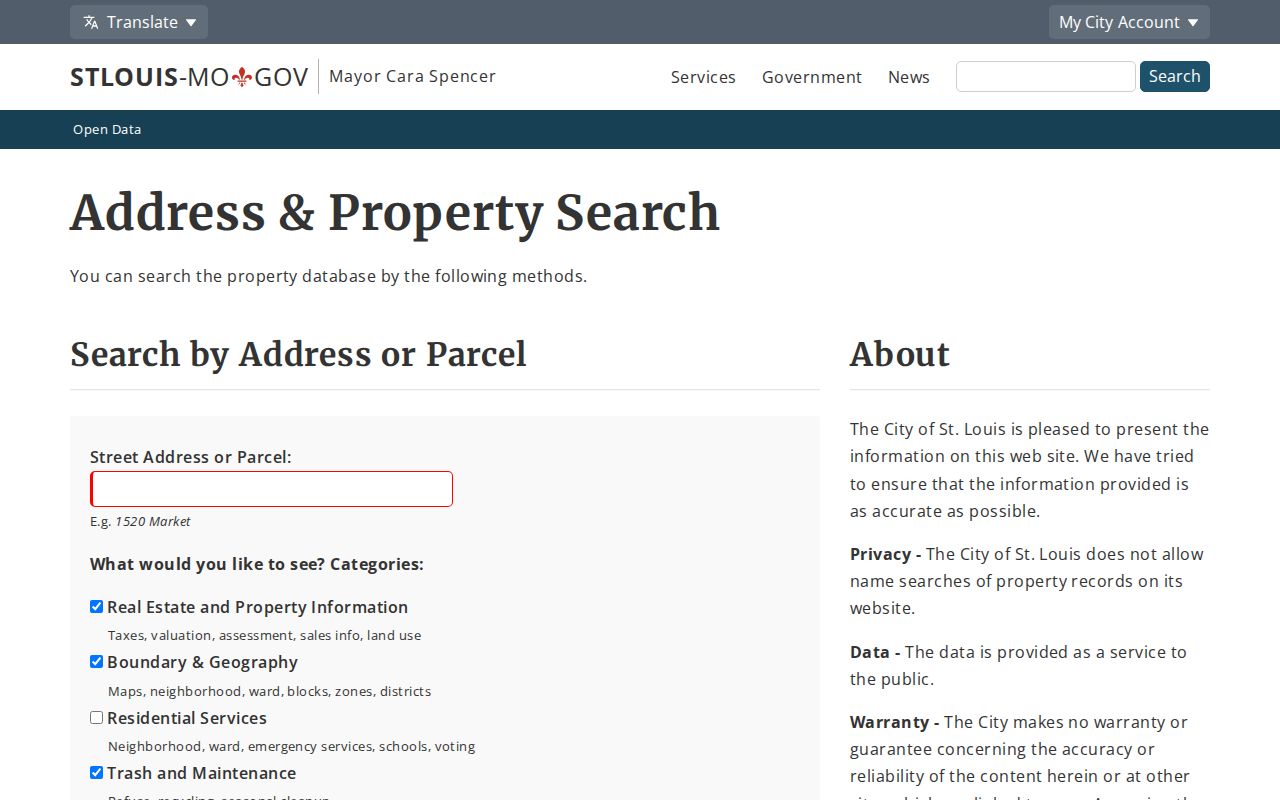
Use the parcel and legal-description details as a bridge to the Recorder. They are no substitute for a recorded instrument.
- Parcel
- A local identifier for a piece of land or a unit, used to join City property and mapping material.
- Situs address
- The physical property location. It may differ from the owner’s mailing address.
- Collector account
- A tax-account identifier that is distinct from the parcel number and can help keep a property trail organized.
- Legal description
- The block, lot, subdivision, or other land description used to identify property in recorded work.
St. Louis Deed Names Follow the Land
Ownership trails run through the City Recorder DirectSearch index. Search the current owner as grantee first. Then walk the chain backward. Each prior seller becomes the earlier grantee in that next search. Record the recording date and document type. Note the book/page or document number, legal description, and whether an image or copy exists. Deeds name more than residents. A spouse, trustee, lender, estate, or corporation can appear. So a deed identifies an instrument party rather than automatically a resident.
City guidance describes an online address, grantee, grantor, or parcel workflow for July 1982 forward. Older deeds take more work. The Recorder or Assessor counter, public computers, old books, and book/page references cover that earlier stretch. Requests come in person, by mail, or online. A book/page search at the counter takes about 15 minutes when the reference is known. Mail is often handled the next day.
Note: A missing online deed result does not prove a St. Louis property had no earlier owner or that its older instrument is unavailable.
Current St. Louis Resident Directories
St. Louis keeps its current directory evidence scattered. The City property page names a current owner at a known parcel. The Recorder index names parties to recorded instruments. Voter lookup answers one exact registration question. Case.net lists litigants, not every witness or resident, and business or professional registers show an organizational or credential tie rather than a home address. Match the source to the question, and note its access limit beside each result.
| St. Louis source | What it can identify | Custodian | Access route |
|---|---|---|---|
| City address/property result | Current owner, mailing and situs address, parcel context | City Assessor | Free address or parcel search |
| Voter registration | Matching registered voter and district clues | Missouri election authorities | Exact-person lookup and limited request routes |
| Recorded instruments | Grantors, grantees, legal descriptions, and dates | City Recorder | Free index, paid copies or counter help |
| Case.net | Litigant, case, docket, and disposition information | Missouri Courts | Public web search and courthouse terminal |
| RNO directory | Public neighborhood-group contacts and meetings | City Neighborhood Stabilization Office | Registry and association directory |
One name is the target for many lookups. The focused St. Louis resident lookup handles exactly that task. It sorts usable public evidence away from same-name collisions and restricted records, so a match means something.
St. Louis Voter Records Have Exact Limits
Missouri Voter Outreach is the state's registration portal. Its lookup form asks for a registered first and last name, date of birth, the last four Social Security digits, and the county. That is a lot of detail. City guidance sends voters with inactive listings or nonstandard addresses to the City Board of Election Commissioners for sorting out. The public voter-file statute, RSMo 115.157, lists fields such as name, year of birth, address, ward, and precinct. Even so, it does not create a full online residents directory for St. Louis.
Some records sit outside ordinary access. Safe at Home addresses stay protected, along with other shielded fields. An election authority may offer a fee-based voter-file request tied to a defined geography or election history, but no City-wide public name roster exists under this route. Missouri also restricts commercial use and misuse of voter information. So treat any registration match as one confirmation layer in a broader St. Louis residents directory search, never as the whole answer.
St. Louis Court and Custody Sources Are Narrow
Case.net works only for litigants. A person must actually be a party to a case before the system returns anything. Searching is possible by litigant name, filing date, case number, or scheduled hearing. City municipal instructions point to the 22nd Judicial Circuit. They allow an optional date of birth, a St. Louis City Municipal location, and a Traffic/Municipal case type. Sealed, juvenile, adoption, and expunged material stays invisible no matter what name is typed.
Custody lookups are narrower still. The City's inmate locator demands an exact first and last name. Results cover custody basics only: name, birth year, race, sex, and facility. A blank result could mean release, transfer, a spelling mismatch, or police custody. For a current-status question, call the City Justice Center or Prisoner Processing. That beats stretching an online result beyond its purpose. None of this adds up to a general St. Louis resident record.
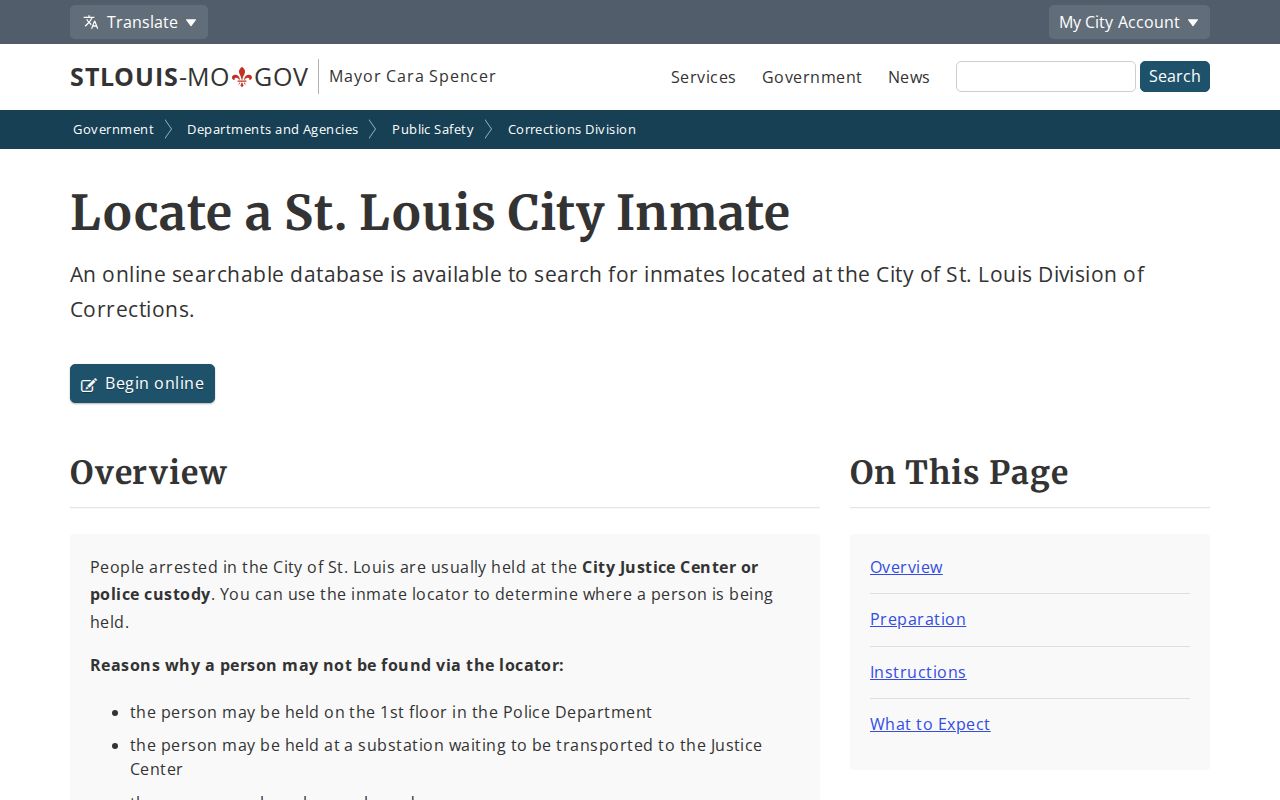
The City instructions make one thing plain. An exact name matters, and a custody search is not a general St. Louis resident record.
Historical St. Louis Resident Directories
The St. Louis County Library owns a remarkable run of city directories. It holds the 1821 volume and selected volumes from the 1840s and 1850s. Every year from 1864 through 1931 survives on microfilm. Later selected years run through 1980. Nearby shelves carry business directories, telephone books, and maps. The same shelves hold court transcriptions, burials, death registers, and local histories. The 1922 city directory documents a reverse section that runs from address to occupant. That layout helps when the name is the missing piece.
St. Louis Public Library brings its own strengths. Its offerings include local-history research, obituary indexes, licensed databases, maps, and special collections. The Missouri Historical Society searches by personal name, business or corporate name, street address, and source. For going deeper, the St. Louis city directory collection guide explains how to read a volume. It also shows how to pair a yearly entry with maps and census material. Old directories reward patience.
St. Louis Libraries Keep the Missing Years
Online access to these volumes is uneven. A given year may live on microfilm, microfiche, print, a library database, or an archive shelf rather than an open website. Ask a St. Louis County Library History & Genealogy staff member for the right year and format. St. Louis Public Library's genealogy and St. Louis Room resources work as another route. Either channel can connect a directory entry to an obituary index, a newspaper reel, a Sanborn map, a cemetery source, or a probate lead. Those links matter.
The City property service has shown data-connection problems of its own. That makes an office, library, or archive fallback a practical plan rather than a backup idea. A City Recorder archive search can also cover historic birth, death, marriage, land, and genealogy material when a modern portal lacks the needed year. Fallbacks are not defeat; they are how past residents of St. Louis usually get found.
St. Louis Vital Records Require Eligibility
Missouri does not treat vital records as an open collection. You cannot sweep them with a simple resident lookup. The Department of Health and Senior Services limits certified copies. Only people with authorization or tangible interest qualify. Apply in person and you show identification. By mail, you send a signed, notarized application, the fee, any supporting documents, and a self-addressed stamped envelope. The statewide register starts in 1910 for births and deaths. Marriage and divorce statements run from 1948 forward.
Missouri's official order guidance lays out the application path step by step. Under RSMo 193.245, death copies older than 50 years can be disclosed more freely. For earlier generations, the St. Louis residents directory era before 1910 turns to Missouri Digital Heritage. The City Recorder archives hold older City search services, including marriages from roughly 1805 or 1806 through 1931.
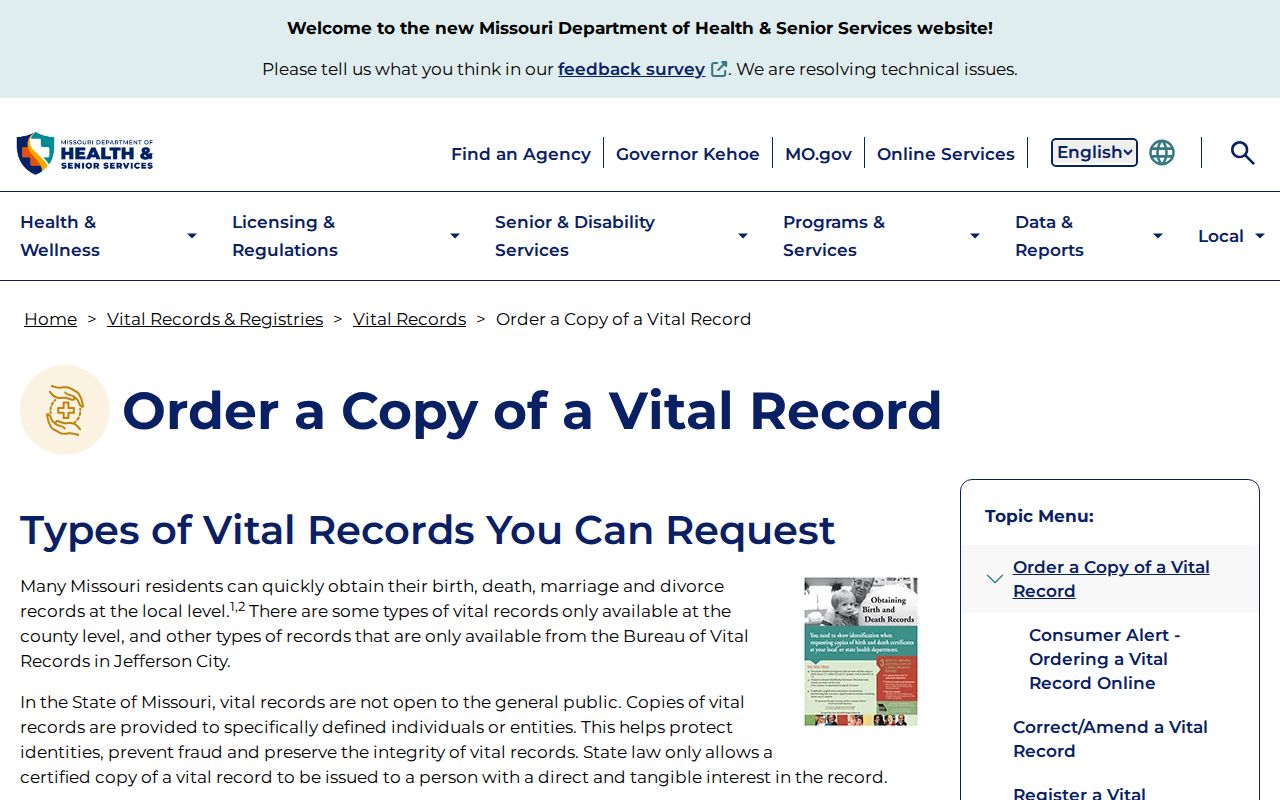
Eligibility gates every vital record request in St. Louis County.
St. Louis Residents Directory History Trails
An old address can become a family-history trail. It works when a same-era directory, deed, obituary, and probate record all agree. A directory supplies an address and occupation. A recorded instrument can establish an ownership change. An obituary may give a death date, relatives, or a final-address clue. Probate can identify an estate representative or an heir. Keep the source date and record type attached at every step rather than flattening all names into one identity.
City archive resources, library obituary indexes, and cemetery material make strong historical endpoints. Washington Park Cemetery North has a City archive reinterment index covering 11,974 deceased people, including 165 entries identified as Doe. The City reports no records at all for Washington Park South. That gap is worth recording as an absence rather than converting into a conclusion about a family. Documented silence is itself a finding in a St. Louis residents directory search.
St. Louis Registry Searches Need Context
Missouri runs several separate lookup systems, and a St. Louis resident search can land in the wrong one without warning. The Missouri State Highway Patrol publishes a public sex-offender registry that searches by name, date of birth, city, county, ZIP, street, and address radius. It updates daily. Still, its map has gaps, and the search carries use limits. The City locator, the Missouri Department of Corrections search, and the federal custody locator each cover a different system. A City arrest does not automatically create a state custody record. A registry hit is not a biography.
The Missouri registry search interface displays its name and address-radius controls side by side. Match the question to the right official source. Keep the coverage limit attached to any result.
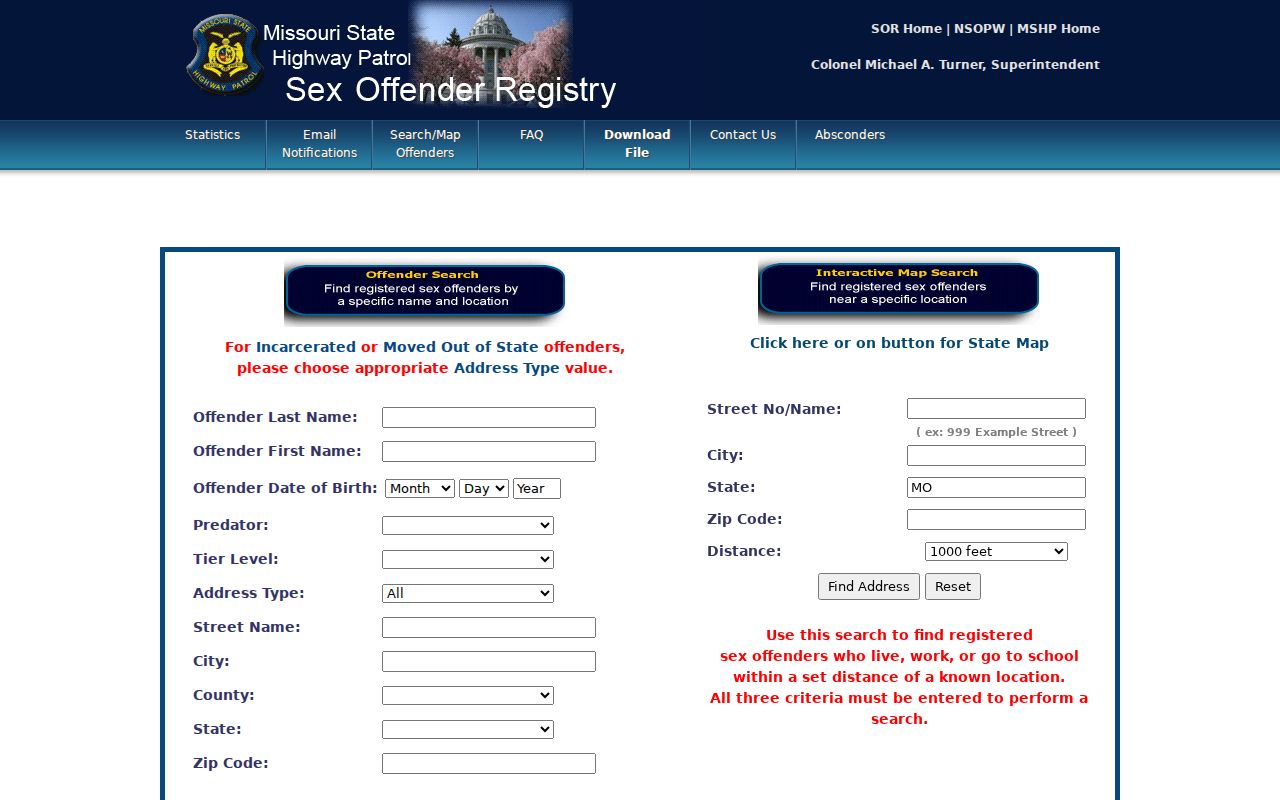
This screen makes the boundary plain. Location fields filter one registry. They are not a St. Louis household directory or resident lookup.
St. Louis ZIP Labels Are Not City Limits
A ZIP code is delivery geography. It does not draw the independent City boundary. It does not mark a neighborhood or ward. It does not tell you which office holds a record. The City GIS service layers ZIP Codes, Neighborhoods, Wards, City Blocks, City Limits, and related data. A property result adds local context of its own. Standardize any known address with USPS first. Then confirm the boundary and parcel before picking the City or County path.
The conventional City list runs 63101 through 63120 in specified areas. Then come 63139 and 63147, plus special or unique delivery codes. Several County ZIPs nearby carry a St. Louis mailing label too. The ZIP code directory keeps delivery geography apart from records jurisdiction.
St. Louis Record Claims Need Source Checks
Official records and compiled commercial listings are not the same thing. A custodian’s result names a particular record, its access condition, and its date. A compiled listing can go stale. It can merge two people with one name, or repeat an old mailing address. Before treating a match as one person, weigh at least two independent identifiers. A name plus a parcel or legal description works. So does a name plus a documented organizational affiliation.
| Record path | Best use | Key caution |
|---|---|---|
| Official custodian index | Verify a specific public record or instrument | Coverage and access vary by office and year. |
| Library or archive collection | Trace a historical person, address, or local event | Many volumes require an in-person visit or reference help. |
| Compiled commercial listing | Possible lead only | Confirm every claim with the underlying custodian. |
St. Louis Fraud Warnings Follow Parcel Searches
Parcel searches attract deceptive mail. The City Recorder's official land guidance is the safe starting point for a deed copy or Property Fraud Alert details. Compare any mailed offer against the Recorder's fee schedule. Then call the office directly instead of using a number or payment link from the mailing. After the May 2025 tornado, the City postponed a real-estate tax sale touching 1,264 properties. It also warned residents about predatory letters and payments.
Unclaimed-property claims deserve the same caution. The Missouri Treasurer's search states plainly that the State charges nothing to claim property. If you report a deceptive solicitation to the Missouri Attorney General's consumer-protection office, keep the letter. Also keep the envelope, payment demand, and URL.
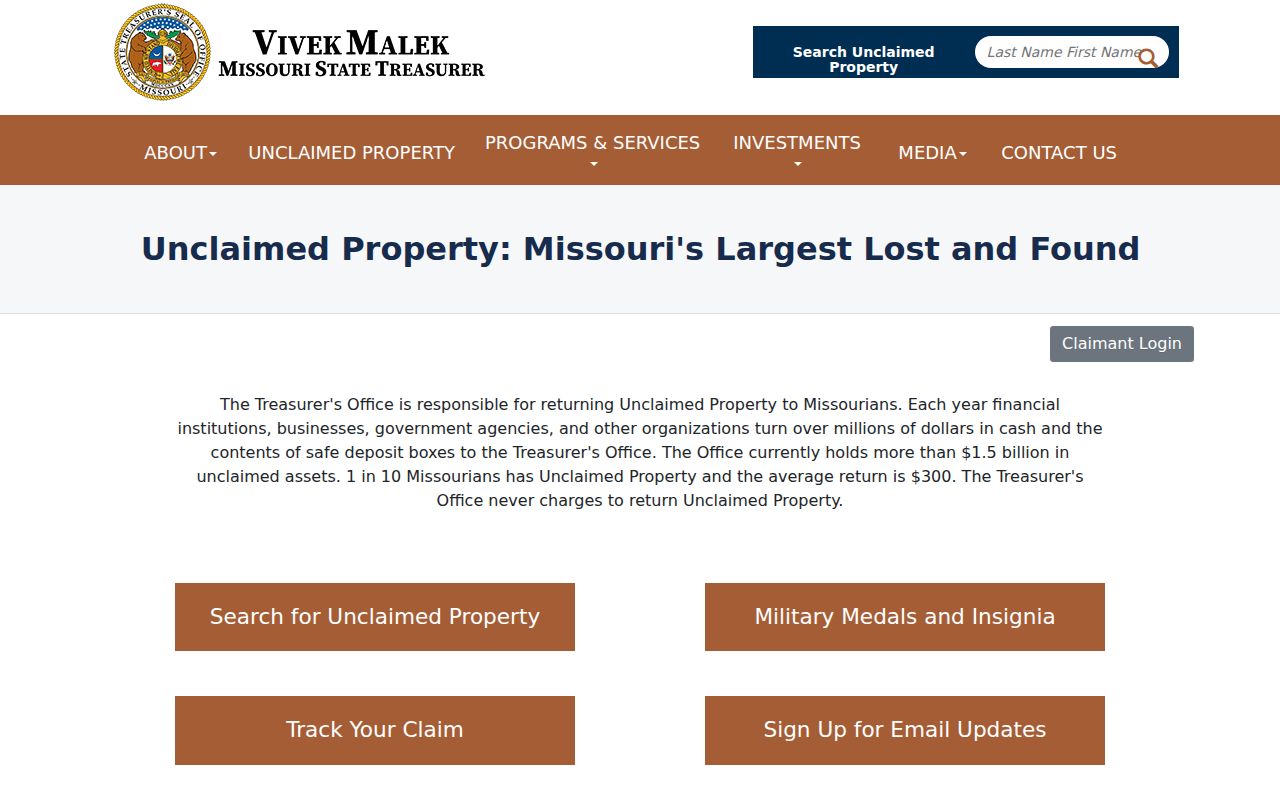
The State’s own claim screen settles the question. It is the right point of comparison whenever a fee demand uses a St. Louis name or address as bait.